


Shiloh National Military Park - part II - The Terrible Battle of Shiloh

Shiloh National Military Park is a very solemn place
Today we know that the American Civil War was a sad, sad, tragic event, the darkest period in American History.

But in late 1861 when the war had just started, and along into early 1862, the country still did not know what a sad and tragic event the war would be. Each side in the war shared one view. Each side thought that "because our side is so right and justified, those other men will surrender as soon as we show them that we are going to fight. And if necessary we will fight long and hard." Both sides shared that view. Both sides couldn't be right, and that was a recipe for a long and bloody war.

Just south of Savanah, Tennessee, there on the west bank of the Tennessee River, lies Shiloh National Military Park. Shiloh is the site of the largest early battle of the Civil War. It is a National Park and as such it is a beautiful place and is well managed for the public, with emphasis placed on educating the public on what happened there back in 1862.

Before the Battle Of Shiloh
In the year 1861 there were numerous battles between the United States army and that of the Confederate states. Two of the bigger battles are noteworthy, Bull Run and Wilson's Creek.

Before Shiloh -The Battle of Bull Run
Near Washington D.C. back in mid July of 1861, Union forces prepared and launched an attack meant to capture the Confederate capitol of Richmond Virginia. The area was defended by Confederate forces. The two armies met just north of Manassas, Virginia in an area called Bull Run.
Confederate forces turned back the Union army and the battle became a victory for the Confederates.
Both nations saw the battle as a bloody and costly affair. The northern army suffered 2,896 killed and wounded. The southern forces suffered 1,982 casualties. People in the south saw that battle as proof that they would soon defeat the entire Union army. The north saw that battle as a minor setback that could soon be made right. Both sides thought that almost 5,000 combined casualties was a very bloody and deadly battle.
Before Shiloh -The Battle of Wilson's Creek
Also in 1861, in the western theatre of the war, opposing forces gathered in the area just south of Springfield, Missouri. In early August as southern forces were moving northward they were met by Union forces near an area called Wilson's Creek. The fighting was fierce and eventually the Union forces retreated back to Springfield. Because of their heavy losses, the Confederate forces did not press the matter further.
In the Battle of Wilson's Creek, Union forces suffered 1,235 casualties. Confederate forces suffered 1,095 casualties. Once again, southerners saw the battle as evidence that they could beat the Union army anytime, anywhere. The northerners saw that they needed to do better next time. Both sides saw the total casualties, being over 2,000, as proof that Wilson's Creek was a terrible and bloody battle.
War Strategy
Even before the first shots of the war were fired at Fort Sumter, all military strategist knew that a civil war would be won by the side that could control the transportation and supply lines - the major railroads and major rivers. In early 1862, control of those railroads and rivers was starting to come true for the northern army.

Led by General Ulysses S. Grant, the Union army had taken control of two Confederate forts, Fort Henry on the Tennessee River and nearby Fort Donelson on the Cumberland River.
Supported by gunboats and troop carriers of the US Navy, Grant planned to travel south on the Tennessee River to capture Corinth, Mississippi. Corinth was a railroad center and was located not far from the Tennessee River. From Corinth, rail lines ran both north/south and east/west. To capture Corinth would take control of that railroad center plus serve as a later jumping off point for attacks further south to eventually control the Mississippi River by capturing the river town of Vicksburg, Mississippi.

The Confederate Army, led by General Albert Sidney Johnston, was not caught by surprise. As the Confederates learned that Grant was working his way south on the Tennessee River, they gathered 43,000 troops in and around Corinth, Mississippi from all around Alabama, Tennessee, Mississippi, and other parts of the south. Thus the stage was set for the terrible battle of Shiloh.

The rebels were also aware that northern general Don Carlos Buell was likely to move troops southwest out of Nashville to join up with Grant before the final push into Corinth. So the Confederates decided to strike first. They planned another Confederate victory over the invading Yankee forces by attacking Grant before he was ready and before the additional troops of General Buell joined up with Grant. Grant led 39,000 troops. Buell would later bring 17,000 additional men.
One practice of that time was to name armies after major rivers or waterways. For the northern forces, the army serving under General Buell was called the Army of the Ohio, named after the Ohio River. Grant led the Army of Tennessee named after the Tennessee River. For the southern forces, Johnston led the Army of the Mississippi.
The Terrible Battle of Shiloh
So Johnston launched the Army of the Mississippi going north from Corinth on April 3rd, 1862. To move 40,000 men and their equipment is a big job. Even though they had to travel only about 20 miles, the rainy weather and lack of good roads made the traveling slow. The attacking army arrived on the battle scene early in the morning of Sunday, April 6th.

On that day, Grant's Army of the Tennessee was camped on the west bank of the Tennessee River at a place called Pittsburg Landing, just north of the Shiloh Methodist Church. Buell's Army of the Ohio was northwest of there, about a day's travel away. The Rebel Army caught the northern forces totally by surprise.
While the northern army was eating breakfast on April 6th, the rebels attacked their southern lines. The Union army fought as they fell back to the north toward Pittsburg Landing, taking heavy losses. As the day moved on it appeared that it would be a victory for the south, even though they also took heavy losses.

As the Union forces fell back they came to an old roadbed running across the battlefield. That roadbed was sunken into the ground from years of usage. It was just north of a large open field called Duncan Field. That sunken road gave the Union troops a good spot to set up a strong defensive position and led by Union General Benjamin Prentiss, they did just that. The fighting there was so heavy the southern soldiers called it The Hornet's Nest. There the Union forces delayed the southern men just enough for the other northern forces to organize and draw a strong line at Pittsburg Landing.

It was during that first day of fighting that Confederate leader, General Johnston was wounded in the leg. The bullet cut a main artery and Johnston died from loss of blood. Overall command of the southern forces passed to General P.T. Beauregard.

As Grant's union forces were falling back and reorganizing the lines near Pittsburg Landing, Confederates set up a long line of cannons to fire across Duncan field and heavily damage the Union Forces in the sunken road.
There the Union forces under General Prentiss were surrounded and surrendered. But their fight had given Grant enough time to draw strong lines at Pittsburg Landing. As night fell on the battlefield, it looked like a southern victory, but Grant had held at Pittsburg Landing and Buell's forces did arrive there during the night.


Storms moved in and heavy rain fell that night. Near Pittsburg landing Grant set up his command under a large oak tree. There he sat and pondered the situation that night as he received a visit from his subordinate and friend General Tecumseh Sherman. Sherman told Grant, "Well Grant, we've had the devil's own day, huh." To which Grant replied, "Yes. Lick'em tomorrow though".

When dawn came on the morning of Monday the 7th the Union forces launched a counterattack. The fighting that day was heavy and terrible. Confederate forces were driven back as both sides suffered heavy losses.
That afternoon Confederate General Beauregard gave the order to retreat and return to Corinth. The rear guard assignment was given to then Colonel Nathan Bedford Forrest. As the Rebels moved south pursued by Yankees led by Generals William Tecumseh Sherman and Thomas Wood, Confederate Colonel Forrest personally led his men and attacked the Union forces. Forrest, in spite of being shot and having his horse shot out from under him, took another horse and rode away. That ended the Battle of Shiloh.


The nation was shocked to learn of the numbers of dead, wounded and captured in that battle. Losses killed, wounded or captured, were 13,047 Union and 10,669 Confederate. That was the bloodiest battle ever - ever - fought on American soil at the time.

Even with more casualties, the Union held the ground and is considered the victor. It was the beginning of a long, long, string of defeats to be suffered by the Southern forces in a war that would see more than six hundred thousand Americans killed.


The citizens, both Nort and South were shocked at the death and carnage of the battle. Before the battle they looked as Bull Run and Wilson's Creek as being terrible battles. The casualties of those two battle combined were around 7,000 men. Shiloh had almost 24,000 casualties.
Marker at the mass grave of Confederate soldiers Mass grave of Confederate soldiers Marker at the mass Grave
Historians now see that through his efforts, planning, and determination, General Grant was the the real hero of the battle. But shortly after the battle, thousands of Union supporters called for Grant to be relieved of command because of the heavy Union losses.

Grant was assigned to other duties after the battle but would later be recognized by President Lincoln as a warrior and capable general. Grant eventually led the Union army to victory over the Confederates across the entire nation, just as he did at Shiloh.


Pictured above is part of the Confederate monument. The three statues represent the Confederacy in the center, Nighttime on the right, and Death on the left. Here one can see that when Night arrived, the laurel of Victory was passed from the Confederacy over to Death.


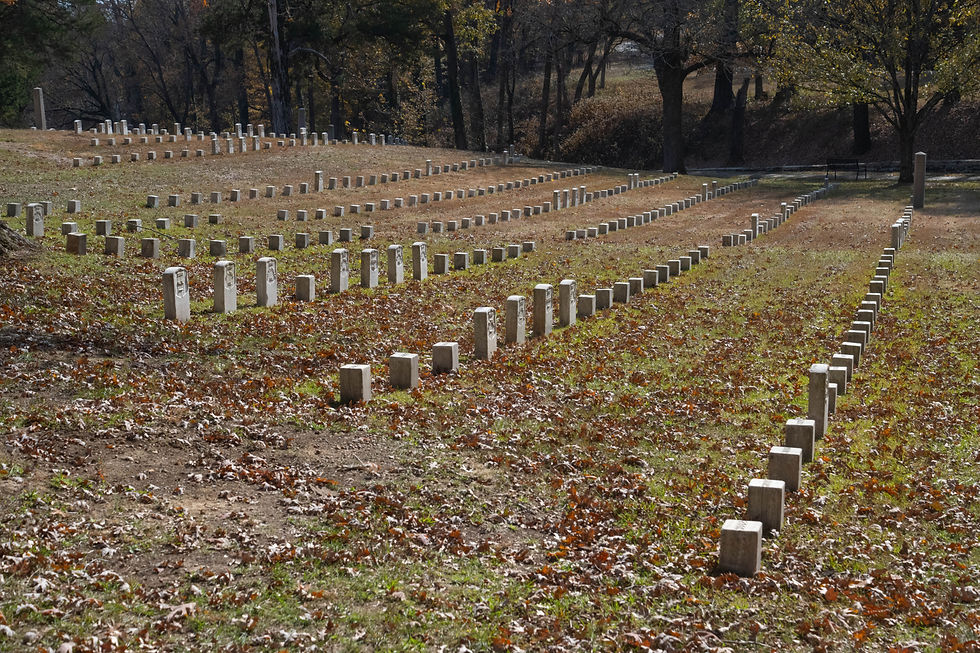

Any American who visits Shiloh can stand and look out over the battlefield and reflect on what happened there - and why it happened.

When this writer stood at Shiloh, the same question came to mind over and over, "Why? How could this happen? How could thousands of good American men fight, and shoot, and kill thousands of other good American men?"
Most men anywhere would kill an intruder if they saw that it was necessary to defend their family or home. How did that idea turn into the battle that took place here?
One might draw the conclusion that there is a darker side to humanity - a side where men set out to kill other men for some cause that they feel justifies that killing. Is that who we are? Are the people of 2025 capable of the kind of killings that happened in 1862? As Americans, are we the kind of people who could do that kind of thing?
And in Closing
Once on a visit to Shiloh I was talking to the father of a family visiting from Mississippi. He and I were looking across a beautiful green field where once hundreds, or thousands, of Americans had fallen. The sky was sunny and the weather was near perfect.
I said, "This place is special. Any American living within a day's drive should visit this place." He agreed. But then I added, "It is a special place, but not a happy place."
Shiloh sits about 20 minutes south of Savanah, Tennessee and about 30 minutes north of Corinth, Mississippi. It is a quiet, isolated place.

Comments are welcomed here in the box at the bottom of this page. I really like reading those comments. You can ask questions there as well. I will try hard to give you a good answer.
Also note that if you hit that "Log In" button at the top of this page and become a member of Picture Americana, you will get an email notification whenever a new blog is posted. I really appreciate people becoming members.
#americana #rockybaker #civilwar #nationalcemetery #illinois #mississippi #michigan #alabama #tennessee #pennsulvania #iowa #shiloh #cannons #confederacy #americanhistory


My Great, Great Grand Dad was introduced to the Elephant at Shiloh. The South continues to declare "Never Apologize for Being Right". This is a commendable work of truth and dedication, thank you!
Thank you for the great article and photos Sir! Best wishes from Poland!
Thanks, Rocky, for these recollections and sober reminders. Let us remember and recommit to living a life of meaning, doing good to all men, fighting evil where we find it, and praising God. Let us rededicate ourselves to freedom and America.
Excellent essay.
Great article, I enjoy reading about the Civil War and especially Grants campaigns. To answer you last question I think if we don’t calm the rhetoric down we are close to being the same nation we were in 1861. Please keep the pictures and stories coming!
Fantastic & very informative information as always Rocky. Just love reading your communications . Ben from England.